
Fire Hazard: The Mounting Costs of Northwest Sprawl
Introduction
Wildfires, for millennia a natural feature of Northwest landscapes, have erupted into arguably the most politically vexing, expensive, and far-reaching climate change challenge in the region. A dangerous recipe of reduced snowpack, earlier snowmelt, drier summers, and extreme heat, mixed with a history of fire suppression, is feeding more severe, frequent, longer-burning, and bigger fires than ever before. Wildfires are decimating the region’s air quality, devouring millions of dollars in state and provincial budgets, and obliterating progress toward reducing carbon emissions.
Despite these realities, more people are packing up and moving into fire-prone areas every day. More than 1.6 million people in the Northwest lived in wildfire hazard areas in 2023,i a figure that has grown eight percent since 2018.ii
About one in ten people in the Northwest live in census tracts facing high or very high wildfire hazard
Sources: FEMA’s National Risk Index for Natural Hazards, 2025 and American Community Survey, 2023.
In fact, in every Northwest state except Idaho, the places where population is growing the fastest are those most at risk of wildfires. In Washington, for example, the population of high-hazard areas grew by nine percent between 2018 to 2023, compared with six percent in low-hazard areas. In absolute rather than percentage terms, of course, most population growth has occurred in low-hazard areas—large metropolitan centers such as Portland and Seattle. But from 2018 to 2023, more than 121,000 people still moved into the parts of the region most likely to catch fire.
All northwesterners, no matter where they live, bear the consequences of continuing to build houses in fire-prone areas. They pay more taxes to cover the escalating costs of firefighting. They pay higher insurance rates to cover insurers’ catastrophic costs from fires. They pay increased energy bills to cover utilities’ costs for fireproofing their infrastructure to power new developments in risky areas. And they pay with their health when they breathe smoke from fires, sometimes hundreds of miles away.
Reining in these mounting costs requires reforms few politicians would promote in a stump speech. It would mean ending sprawling subdivisions in places likely to burn. It would mean requiring new buildings in high-hazard areas to be built to withstand flames and that all homeowners clear the wood fences, rosebushes, and trees adjacent to their houses. It would mean resisting the well-intentioned impulse to rebuild smoldering, devastated communities in places likely to burn again and instead channeling billions of dollars to help low-income families start over on safer ground.
Absent a coalition willing to enact these policies, decisionmakers can chip away at them, whether by changing zoning codes in a willing local jurisdiction, pursuing voluntary versions of ideally mandatory policies, or devoting whatever limited funds are available to help low-income families build or rebuild to better withstand fire. All the while, leaders can daylight the truth about wildfire hazard to homes through accurate insurance and housing data and by making the safer parts of the region more affordable. As the costs of inaction grow harder to ignore, it may become possible to enact the transformative changes necessary to safeguard Northwest communities.
Fire hazard stalks both high- and low-income communities—but with different costs
Growth is fastest in high-hazard, affluent areas that are costlier to rebuild
One-third of northwesterners in wildfire hazard areas live in relatively affluent places, such as the outskirts of Bend, Oregon; the booming edges of Boise, Idaho, and Missoula, Montana; and recreational hubs, including Leavenworth, Washington.iii In Idaho and Montana, more people in high-hazard tracts live in areas the US Federal Emergency Management Agency (FEMA) rates low on social vulnerability—census tracts with relatively high incomes, housing stability, and other socioeconomic advantages—than the other way around (the reverse is true in Oregon and Washington).
Among high-hazard areas, the population of affluent places grew more than twice as fast as the population of socially vulnerable ones between 2013 and 2023.
In other words, in Idaho and Montana, it’s more likely to be people in affluent communities who reside in harm’s way, often in places with access to outdoor amenities or scenic views.
The median household in high-hazard Tract 6.03, on the outskirts of Bend, for example, makes $124,000 a year, and homes sell for a median of $742,000, both 40 percent higher than Oregon’s statewide average.iv The pandemic’s remote-work migration contributed to the area’s booming population, which is 95 percent white and grew by 25 percent since 2018.
Among high-hazard areas, the population of affluent places grew more than twice as fast as the population of socially vulnerable ones between 2013 and 2023. In fact, three-quarters of all seasonal (mostly vacation) homes in the Northwest were in or adjacent to wild flammable vegetation in 2010, where wildfire hazard tends to be high, a share that has almost certainly climbed since.v
Forty percent of the Northwest’s population living in high-hazard areas resides in socially vulnerable places, with fewer resources to rebuild
Still, about 40 percent of northwesterners in wildfire hazard areas live in census tracts that FEMA categorizes as socially vulnerable. People in these census tracts are more likely to face harm, displacement, or catastrophic economic loss when wildfires strike.
For example, in Tract 9410, which includes the Spokane Indian Reservation in eastern Washington, median household income sits around $53,000, 44 percent below the Washington median. One in four residents lives below the poverty line. About two-thirds of the population is Native, and about 20 percent white. The median home value is $136,000, barely a quarter of Washington’s statewide median.
The hundreds of communities that authorities categorized as both high wildfire hazard and socially vulnerable include Chiloquin, in southern Oregon; rural Okanogan County, Washington, towns like Brewster; the Silver Valley in Idaho; and Paradise, in Sanders County, Montana.
Over 40 percent of the wildfire-exposed population in the Northwest lives in socially vulnerable communities
Sources: FEMA’s National Risk Index for Natural Hazards, 2025 and American Community Survey, 2023.
Northwest Tribal communities, many of which are in high-hazard, rural areas, face additional longstanding economic oppression, including by the US federal government damming the Columbia and Snake rivers and their tributaries. The construction of the dams destroyed traditional lands, livelihoods, and food sources—especially, and devastatingly, salmon. The Confederated Tribes of the Colville Reservation, the Confederated Tribes of the Warm Springs, the Confederated Tribes and Bands of the Yakama Nation, and the Nez Perce Tribe are among the region’s Tribes whose reservations are in high wildfire hazard zones.
All northwesterners are subsidizing the risks of building in high-hazard areas
Though thousands of people continue to move into flammable landscapes every year, the vast majority of northwesterners—about 80 percent—reside out of wildfires’ likely paths of destruction. Additionally, about 70 percent of residents of places in the region FEMA has defined as socially vulnerable also live in low-hazard areas. In other words, most of the region’s low-income, economically disadvantaged population does not live in fire country. They, along with everyone in the region, shoulder the rising costs of continuing to pave over fire-prone wild areas with new sprawling subdivisions, strip malls, and vacation properties.
Northwest states fund wildfire suppression largely through statewide tax revenues, even though fires concentrate in few places. In Washington, for example, 40 percent of all wildfires over the past 12 years started in just three counties (Spokane, Stevens, and Okanogan), home to just 8 percent of the state’s population and 12 percent of its land area. In 2024 alone, suppression costs topped $620 million in the Northwest: approximately $350 million in Oregon, $174 million in Washington, $59 million in Idaho, and $39 million in Montana.
New development in fire-prone areas also extends electric distribution lines into fire-prone terrain, increasing ignition risk. Wildfire mitigation expenses and utility liability premiums can end up on every customer’s monthly electric bill.
Most of the Northwest has not yet experienced the full-blown wildfire-driven insurance crisis overtaking other states, especially California. However, if insurers continue to cancel policies due to high wildfire risk, more homeowners will seek out coverage from state-authorized insurers of last resort, or Fair Access to Insurance Requirements (FAIR) plans. When premiums for these plans fall short of payouts, private insurers pass on the shortfall to all customers, no matter where they live or if they’re on the FAIR plan. Plus, insurers selling state- and region-wide products may subsidize high-risk areas by charging higher premiums to people living in low-risk areas, Ishita Sen, Assistant Professor of Business Administration at Harvard Business School, told Sightline.
Smoke delivers the most visceral reminder that wildfire impacts ignore borders. In September 2020, smoke traveled over 100 miles into the Puget Sound region and left Seattle with some of the world’s worst air quality. Inhaling the toxins in wildfire smoke, including particulate matter, has been linked to higher rates of respiratory illnesses (including surges in asthma attacks), cancer, and even premature death.
Smoke affects all the region’s residents, but especially firefighters, the people on whom communities depend to defend their lives and property. In September 2025, the US Forest Service reversed its decades-long ban on firefighters wearing masks to protect themselves following reports of wildland firefighters in their twenties and thirties receiving devastating diagnoses of cancer and lung disease.
The best policy tools: Change where and how the Northwest builds—just like for flooding
The policy solutions to hundreds of thousands of people living in areas likely to catch fire are exactly what one might expect: stopping sprawl to risky areas, retrofitting homes to withstand fire, and rebuilding in places less likely to burn.
In fact, these policies are so commonsense that they have been in place across much of the United States in some way or another for decades—not for wildfires, but for floods. After major floods in the mid-20th century, Northwest states adopted floodplain zoning, building-elevation requirements, and limitations on rebuilding in floodways. These actions came paired with subsidized federal flood insurance as an incentive, but they show that regulating development in environmentally hazardous areas is nothing new.
Currently, no Northwest state prevents sprawl to areas designated as high wildfire risk.
1. Steer homebuilding to low-risk areas
More housing in wildfire-prone areas brings more ignition sources and more people and property in the path of fire. Over the past 30 years, human activity such as campfires, equipment sparks, and arson caused 76 percent of the Northwest’s wildfires. Sprawl into wildfire hazard areas also makes it harder to fight fire with fire. Forest managers routinely forgo prescribed burns and controlled fires near populated areas, although these fires are indispensable for reducing fuel loads and preventing mega-fires.
Land use policies, which determine where development occurs, offer some of the most effective tools for curbing risky construction in fire-prone terrain.
Oregon and Washington’s urban growth boundaries already protect rural areas of the state from development, including farmland and forests (though Washington allows small new towns outside growth areas). Idaho, Oregon, and Washington also require local governments to integrate wildfire risk into land use planning, though they allow considerable local discretion.
However, no Northwest state prevents sprawl to areas designated as high wildfire risk. And Montana expressly forbids local governments from denying development permits to projects in wildfire hazard areas.
By contrast, local communities in the Northwest (and across the United States) opting in to the National Flood Insurance Program (NFIP) must follow floodplain management standards, which include prohibiting new construction in floodways unless engineering studies find that doing so would not increase flood risk. Montana and Washington have also adopted statewide prohibitions on development in designated floodways that go above and beyond the NFIP standards.
Wildfires now demand the same treatment. Notably, just three percent of all tracts in the Northwest are classified as very high wildfire hazard, so such policies preserve the opportunity to address the region’s housing shortage (and resulting high home prices and rents). They also spare residents the highest-risk homes and mounting costs to insure them—or that can devastate families when the homes burn.
2. Build, landscape, and renovate homes to withstand fire
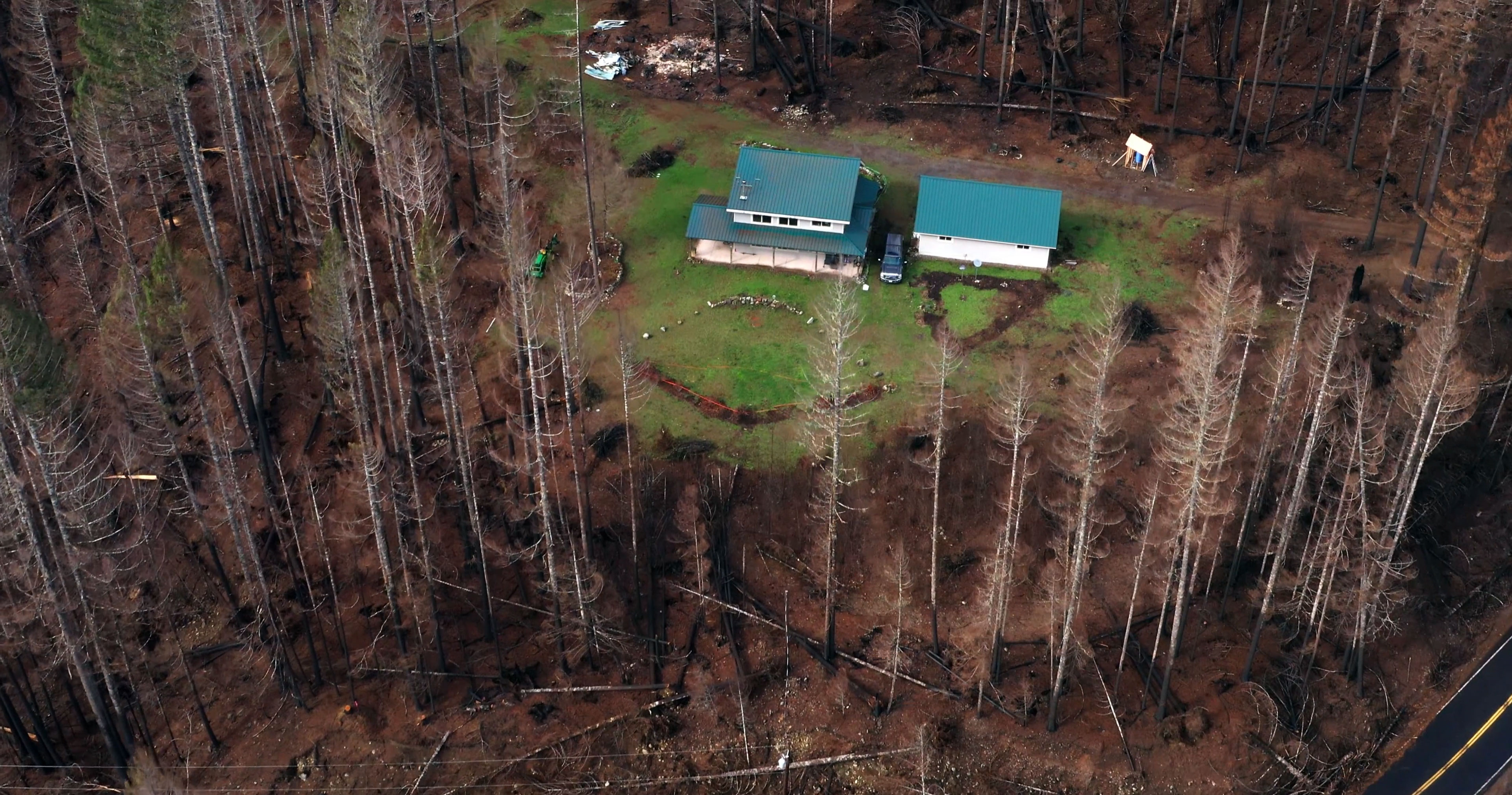
For development that state and local governments nonetheless allow in high-hazard areas, the Northwest can at least help homes withstand wildfires. Wildfire-resistant building codes for new buildings that, for example, standardize metal roofing or non-combustible siding prevent ignition and slow wildfire spread. “We need to build structures that have a chance to survive,” said Steve Hawks, Senior Director for Wildfire at the Insurance Institute for Business & Home Safety, in an interview with Sightline.
Several states, including Florida, have long relied on building code standards for floodplains. Just as it makes little sense to build at or below likely flood levels in a floodplain, it makes little sense to build with flammable materials in a wildfire hazard zone.
California’s Wildland Hazards and Building Code standards, the strongest in the United States, cut structure loss during wildfires by 40 percent, while adding just 2–3 percent to traditional construction costs, according to Headwaters Economics. (Because the benefits accumulate gradually over time, California’s ongoing wildfire crisis reflects increasingly extreme wildfire conditions and decades of legacy, fire-exposed homes, not a failure of fire-resistant building codes.)
Washington is the only Northwest state with a law on the books governing wildfire building code standards. In 2025, Oregon lawmakers repealed their state’s wildfire hazard map and accompanying building codes following misinformation and backlash from property owners. Localities in Oregon may now choose to adopt or ignore wildfire building codes. Washington’s still-standing 2024 legislation creates wildfire hazard maps and adopts parts of the International Wildland-Urban Interface Code in high-hazard areas.
Idaho lacks a statewide wildfire building code but at least grants local governments the freedom to exceed state standards.
Once again, Montana lags; it is the only state in the region that forbids local governments from elevating wildfire-related (or any other) building standards above state codes.
Just as it makes little sense to build at or below likely flood levels in a floodplain, it makes little sense to build with flammable materials in a wildfire hazard zone.
Building codes, however, only apply to new construction, so people already living in high-hazard areas need different solutions, especially given that their homes are likely their largest asset. States could broaden building codes’ reach by conditioning greenlighting of major exterior renovations on building fire-safe homes, following the lead of Colorado. Policymakers could also provide grants to low-income families living in the very highest-hazard areas to bring their homes up to code, where research has shown these retrofits are cost-effective.
Less costly than whole home retrofits would be standards for defensible space—an area clear of debris, vegetation, and other flammable materials around a home—applied to all buildings (new and existing) in high-hazard areas. California requires homeowners in wildfire-prone areas to maintain up to 100 feet of defensible space around homes—thinning or spacing vegetation, for example, so fires have less fuel. The state is now raising standards for the most ignition-prone zone, the five feet next to the house (known as zone zero), so that perimeters remain free of combustible materials and vegetation. After several years of delay following homeowner and some local government pushback, the rules are expected to take effect in 2026, applying immediately to new homes and phasing in over three years for existing ones.
3. Facilitate rebuilding out of harm’s way
After catastrophic fires destroy homes and displace families, governments understandably prioritize helping survivors rebuild quickly. But doing so can put communities back on the “wildfire treadmill.”
“After a wildfire, sometimes the immediate response is to rebuild bigger and better, which may be a mistake,” Benjamin Keys, Professor of Real Estate and Finance at the University of Pennsylvania’s Wharton School, told Sightline. Homes that burned once are at high risk of burning again.
States can prioritize helping families rebuild in safer locations, including by funding relocation for displaced low-income families. Especially if families are tied to their burnt-down property with a mortgage, they may face no other real option than rebuilding in the same risky location. Federal flood buyout programs offer one analogue; these have given families more options to rebuild on or move to higher ground after disasters.
For Tribes living in high-hazard zones, however, voluntary post-disaster relocation could evoke the painful history of forced displacement. At the same time, some Tribes are actively pursuing relocation for safety from climate disasters but struggle to secure adequate funding or suitable land. In all cases, Tribal-led initiatives that uphold Tribal sovereignty and protect cultural continuity stand the best chance of success.
“After a wildfire, sometimes the immediate response is to rebuild bigger and better, which may be a mistake.”
–Dr. Benjamin Keys, University of Pennsylvania
States can also ensure that insurers don’t restrict payouts for rebuilding on a new site. Oregon, along with Colorado and California, explicitly guarantees that homeowners can use insurance proceeds to purchase a replacement home elsewhere rather than rebuild on the original site (protections that emerged after some insurers restricted payouts for off-site rebuilding). Other Northwest states could codify this right, currently established through court precedent.
At a minimum, states can resist the temptation of weakening building codes in the wake of disaster. After the 2020 Labor Day fires, Oregon weakened building code standards and land use regulations for rebuilt structures, potentially putting them at risk for another disaster. (Washington considered a similar idea in 2023, but lawmakers ultimately maintained current standards.) Oregon could update the state’s post-disaster rebuilding rules so all replacement homes follow current standards, while restoring grant funding for families who cannot bear the added cost.
Honest wildfire hazard information may usher bigger changes
If the lack of action in the wake of the 2025 Los Angeles wildfires—likely the most expensive wildfires in US history—is any indicator, enacting the transformative land use and building code reforms that the wildfire crisis demands is going to be hugely difficult. Less than a year after that fire killed more than 30 people, destroyed thousands of homes, and displaced tens of thousands of residents, state and city leaders are rushing to facilitate permits to rebuild in the affluent Pacific Palisades, which CalFire classifies as a “very high” fire severity zone. Meanwhile, Los Angeles city officials are balking at state regulations to clear defensible space around homes to reduce fire risk.
Even in Oregon and Washington, local governments and developers are pressuring state leaders to weaken the very growth boundaries that prevent worsening disasters. And appetite among lawmakers in power for fire-adaptive land use policies is likely to be non-existent in Idaho and Montana.
Plus, funding relocation for people to rebuild in safer places could cost billions. Acquiring just 30 percent of the 100,000 owner-occupied homes in the Northwest’s highest-hazard zones (roughly the proportion of low-income households) would cost around $15 billion, Sightline estimates.vi For comparison, FEMA has paid $4 billion to purchase 45,000 flood-prone homes nationwide since the 1990s.
Acquiring just 30% of the 100,000 owner-occupied homes in the Northwest’s highest-hazard zones to enable voluntary relocation to safer ground would cost around $15 billion. For comparison, FEMA has paid $4 billion to purchase 45,000 flood-prone homes nationwide since the 1990s.
Still, leaders can try to implement versions of these reforms where possible, perhaps on a local scale or a voluntary basis. At the same time, they would do well to focus on creating the conditions for more transformative changes later. One way is by legalizing abundant, affordable housing in low-risk places, with solutions like those Sightline has been championing for years. At present, housing shortages in pricey but less fire-prone Northwest cities, such as Seattle and Portland, squeeze some people into high-hazard areas and give everyone fewer options of where to live. Land use restrictions in the safer and expensive metropolitan area of San Diego, for example, have driven a 7 percent increase in population in nearby wildfire hazard zones.
More immediately, leaders can also shine a light on the true wildfire risk to Northwest homes, making the problem impossible to ignore.
4. Standardize home hazard disclosures
Across much of the Northwest, state laws leave renters and homebuyers largely in the dark about whether a property sits in a wildfire hazard zone. In Washington, landlords have no obligation to disclose wildfire hazard to renters. And while home sellers must disclose past fire damage and whether a property lies in a floodplain, they do not have to disclose whether the property sits in a wildfire hazard area. The same is true in Idaho and Oregon. Montana relies on a general duty to disclose environmental hazards a seller happens to know.
These gaps matter even more now that private actors are pulling back from transparency. In late 2025, Zillow, the United States’ largest real estate listings site, removed wildfire and other climate risk scores from home listings following pushback from the real estate industry. Policymakers can counter this retreat by requiring clear, upfront wildfire hazard disclosures for all homes.
5. Accurately price risk into home insurance
Another way policymakers can help northwesterners understand true wildfire risk, while protecting those living in low-risk areas from having to subsidize homes in high-risk areas, is through property insurance markets.
Every state regulates the companies that sell insurance coverage to its residents. And, while all regulators aim to protect consumers via “fair, competitive, and healthy insurance markets,” states’ rules and guidelines for achieving those goals vary widely. Researchers have found that, as a result of this heterogeneity, insurance rates are increasingly diverging from properties’ actual climate risk in many states. This “decoupling” of rates and risk leads to insurers charging artificially low rates in high-risk places with restrictive regulations (or leaving the market entirely), subsidized by artificially high rates in low-risk places with more lenient regulations.
California was, until recently, the poster child for a restrictive insurance regulatory regime, and people in low-risk parts of more lenient Northwest states may very well have paid higher insurance rates as a result. Most notably, until 2024, California barred insurers from using forward-looking catastrophe models when setting premium rates, a pivotal factor in calculating future costs, especially as the risk of climate disasters changes and accelerates.vii
Other examples of regulations that can distort pricing include preventing insurers from using past claims to determine coverage or rates (as Oregon does) or preventing insurers from using geographic considerations (like zip codes) in setting rates. In Washington, because filings are public and insurers must get regulatory approval before changing rates, insurers are reticent to use property-level wildfire risk models, for fear of exposing proprietary information to competitors. Lawmakers in Washington introduced legislation in 2026 to protect information about wildfire risk models as trade secrets and encourage more accurate pricing.
“For households living in high-risk areas, [insurance] prices have to go up. There is no getting around that.”
–Dr. Ishita Sen, Harvard University
In the short term, regulations aimed at tamping down rates for weary constituents might be politically popular for lawmakers, positioning them as reining in opportunistic insurance companies. However, they can obscure the true risk wildfires pose, leave residents with fewer options to secure their homes, and lead to higher rates for people (including low-income residents) who do not face wildfire risk.
“For households living in high-risk areas, [insurance] prices have to go up. There is no getting around that,” affirmed Dr. Sen, the Harvard Business School professor, and an author of research cited above.
Northwest states aren’t yet facing California’s insurance crisis, nor have they imposed regulatory regimes as restrictive as the Golden State’s (until it enacted recent reforms). As of 2024, average homeowners’ insurance premiums reached approximately $2,800 in Montana, $2,100 in Washington, $1,700 in Oregon, and $1,600 in Idaho. These figures represent increases, from 2014 to 2024, of 106 percent in Montana, 66 percent in Washington, and 46 percent in both Oregon and Idaho. Even so, all Northwest states except Montana remained below both the US national average ($2,700) and California’s ($2,300) in 2024, though premium growth in Washington and Montana outpaced both over the past decade.
Meanwhile, about 1 in 135 households in the Northwest lost insurance coverage entirely in 2023, compared to 1 in 58 in households in California. And about 2,400 households were covered by Oregon’s FAIR plan as of 2024, and just 300 households by Washington’s, compared to half a million households now on California’s FAIR plan. California’s FAIR plan is now facing $4 billion in claims following the January 2025 Los Angeles fires and is pushing higher rates onto people throughout the state.
The situation in the Northwest is changing, though. Jay Bruns, Senior Climate Policy Advisor at the Washington State Office of the Insurance Commissioner, told Sightline, “We started to hear from people in fire-prone areas having a harder time finding insurance. So far, people have been able to find it, but it’s expensive.”
Pressure on policymakers to impose price-distorting regulations on insurance companies will no doubt follow. Already, Oregon explicitly prohibited insurance companies from using the state’s own hazard map as a basis for denying coverage or raising rates, before going on to repeal the map itself. Oregon is now considering requiring insurers to receive regulator approval before relying on catastrophe models.
At the same time, accurate risk pricing doesn’t mean premiums only rise. Lawmakers could also require insurers to offer discounts on property insurance premiums for property owners to invest in wildfire mitigation, though California’s recent experience shows that discounts may need to be far larger than what insurers are offering to encourage homeowners to pay for retrofits.
Policymakers should also protect low-income households in risky places who may lose coverage entirely if private insurers drop them and costly FAIR plan premiums are out of reach. States in the Northwest could, for example, offer means-tested subsidies for FAIR plan premiums to help low-income families maintain coverage, thereby also easing pressure on government-funded disaster relief programs after a fire. Low-income families on FAIR plans or at risk of losing insurance could also automatically qualify for state-funded home hardening grants that states may create or reinstate.
Leaders’ choices today will determine the devastation of tomorrow’s fires
Wildfires in the Northwest will only become more frequent and destructive, fueled by climate change’s drier and hotter summers. Those directly in the path of fire stand to lose the most, but all northwesterners, including the vast majority of the region’s socially vulnerable population, are paying with both their wallets and their health for continued sprawl in fire-prone areas.
Lawmakers can avoid fanning the flames by changing land use codes to steer new housing toward safer places, fire-proofing construction in fire country, and rebuilding out of harm’s way, especially with funding to help low-income families with few other options. Necessary as they are, none of these reforms is likely to be politically popular.
It may be that from the ashes of the Northwest’s next megafire emerges a coalition willing to enact such policies. Until then, policymakers can create the conditions for transformative measures now by making sure everyone—from homeowners to renters, residents of high- and low-risk areas—knows the true risks and costs of wildfires. All the while, leaders can continue to address the dire housing shortages in low-risk parts of the region, giving northwesterners more safe options to put down lasting roots.
Appendix: Data
Wildfire hazard data is the 2025 Federal Emergency Management Agency (FEMA) National Risk Index data, including expected annual losses from wildfires, social vulnerability scores, and overall risk ratings. Demographic and population data is from the US Census Bureau’s American Community Survey (ACS) 5-year estimates for 2023, 2018, and 2013.
Legal Disclaimer:
EIN Presswire provides this news content "as is" without warranty of any kind. We do not accept any responsibility or liability for the accuracy, content, images, videos, licenses, completeness, legality, or reliability of the information contained in this article. If you have any complaints or copyright issues related to this article, kindly contact the author above.
